

- Regular Price
- MRP 19.99
- Sale Price
- MRP 19.99
- Regular Price
- MRP 19.99
Sold Out
- Unit Price
- per
Everybody needs sun exposure to produce vitamin D, which helps calcium absorption for more robust and healthier bones. A small amount of sun exposure is healthy and pleasurable; but too much can be dangerous even unprotected exposure to the sun's ultraviolet (UV) rays can cause damage to the skin, eyes, and immune system. This damage can lead to skin cancer or premature aging (photoaging).
So, we need to protect the UV rays, and Applying sunscreen is one of the ways to protect the UV rays. And Sunscreen for kids is as important as it is for adults. This is because a child’s skin is more sensitive than an adult's. Children older than six months must use sunscreen to protect themselves from the direct rays of the sun as it has the potential to cause sunburns and other skin problems.
Ultraviolet (UV) radiation is a form of non-ionizing radiation emitted by the Sun and some artificial sources, such as Tanning beds, Mercury vapour lighting (often found in stadiums and school gyms), some halogen, fluorescent and incandescent lights and some types of lasers. While UV rays of the Sun have some benefits for people, though they help create Vitamin D, they can cause a health risks.
Types of UV rays:
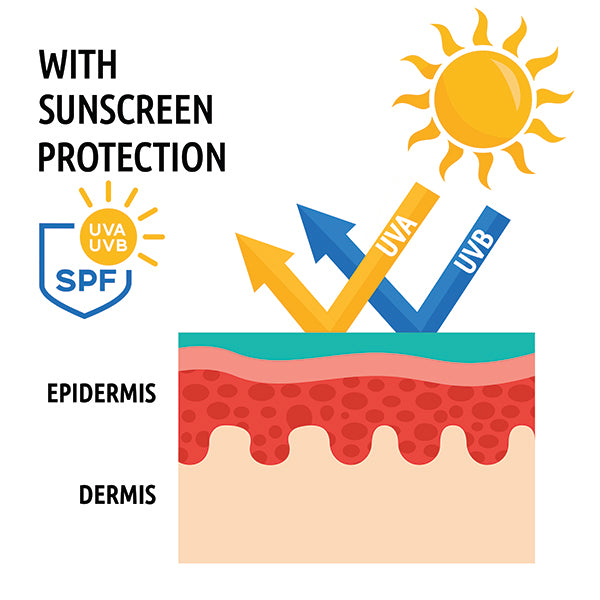
UV radiation is classified into three rays. Ultraviolet A (UVA), Ultraviolet B (UVB) & Ultraviolet C (UVC), based on their wavelength. Almost all UV radiation, mainly UVA & UVB radiation, reaches earth. UVA and UVB radiation can affect health, but UVA penetrates deeper into the skin and is more constant throughout the year.
UVB (290-320nm) rays are responsible for the most severe damages: acute damage- Sunburn, long term damage- skin cancer.
UVA (320-400nm) rays penetrate deeper than UVB and are responsible for tanning, photo-ageing, hyperpigmentation etc.
UVC (220-290nm) rays are entirely absorbed by stratospheric ozone.
The SPF stands for Sun Protection Factor, which measures how much solar energy (UV radiation) is required to produce sunburn on protected skin (i.e., in the presence of sunscreen) relative to the amount of solar power needed to make sunburn on unprotected skin.
As the SPF value increases, sunburn protection increases. SPF value typically refers only to UVB rays. For example, SPF 30 provides more protection than SPF 30. A product with a specific SPF effectively blocks UVB rays but doesn’t make proper protection against UVA rays responsible for skin ageing. That’s why choosing a suitable SPF with broad-spectrum protection is essential. Broad-spectrum sunscreens protect UVA rays in the same way as SPF protects UVB.
What is the PA+++ rating in Sunscreen?
Sunscreen has a PA+++ rating; we have a rough idea of its UVA-PF. UVA-PF stands for UVA protection factor and measures how much a sunscreen offers UVA protection. The PA system sunscreens into groups based on their UVA-PF/ PPD value. The more +’s, the higher the PPD/UVA-PF. PPD and UVA-PF are highly correlated, and values are roughly the same.
UVA-PF is at least 1/3 of the stated SPF value.
UVB radiation is responsible for more than 90% of vitamin D production in the skin. It is said that A few minutes of exposure to summer sunlight two to three times a week is sufficient for Vitamin D synthesis. There is evidence that though sunscreens can significantly reduce vitamin D production under strictly controlled conditions, their normal usage does not generally result in vitamin D insufficiency. (Sowmya Kaimal, 2011)
Sun protection is most important during the peak hours of 11 a.m. to 3 p.m., but School pupils should also wear sunscreen daily as they will be outside for prayers, recess, play and waiting for the school bus etc. (Goldschneider, 2018) Children, especially in elementary school, can have significant sun exposure during the school day. As we know, long-time daily exposure to harmful sun rays leads to the darkness of the skin(suntan), sunburn & redness and can cause cancer later; the summer heat also increases the chances of acne in adolescents. (Health, 2022) The education of children and their parents regarding photoprotection is a must. It should be noted that photodamage can occur in children of all skin types. So, parents must often ensure their children use sunscreen during the summer months though they are inside.
Ideal sunscreen products for children should have broad-spectrum UVR coverage and good photostability, dispersibility, and aesthetics. (Health, 2022).
Sunscreen ingredients fall into two distinct categories: Mineral and Chemical. Mineral sunscreens contain physical UV filters, such as Zinc oxide and titanium dioxide, that offer broad-spectrum UV coverage by reflecting or refracting UV radiation from the skin. Chemical sunscreens contain UV filters that absorb UV radiation and when used in combination, can provide equal benefits. (Adewole S. Adamson, 2020)
Applying sunscreen is essential to protect the skin from harmful ultraviolet radiation. According to The American Academy of Dermatology (AAD), all kinds should wear sunscreen with SPF 30 or higher regardless of skin tone. (Should kids wear sunscreen? A dermatologist answers, 2022)
According to an Indian Journal of Dermatology, venerology and leprology, an ideal Sunscreen would be: (Sowmya Kaimal, 2011)
Sunscreens primarily protect the skin from the short-term and long-term effects of ultraviolet radiation, heat exposure, harmful rays from the computer monitor, Some halogen, fluorescent, and incandescent lights and post-procedure of dermatological skincare routine.
The common indications for the use of sunscreens are in the prevention and management of:
Men, Women and children over six months should use sunscreen daily. This includes people who Tan quickly and those who do not.
Hypoallergenic Sunscreen helps protect the skin for a long time from harmful UV rays with the help of Tinosorb M, which provides the broadest-possible UV protection based on micro-fine organic particle technology. It is highly efficient at low concentrations and free of preservatives to prevent long-term skin damage. It is the first sun filter using microfine particle technology, acting as a micro pigment and organic UV absorber. It is a highly efficient sunscreen due to its triple action: UV absorption by a photo-stable organic molecule, light scattering and light reflection by its microfine structure.
Enriched Sandalwood Essential oil gives a soothing & softening effect and relieves itching and inflammation. Its antiseptic quality is helpful with acne, boils and infected wounds. Excellent for Dry & dehydrated skin.
Olive oil helps in intense moisturisation with the goodness of Vitamins, mostly E & K and A & D. It also helps prevent sunburn.
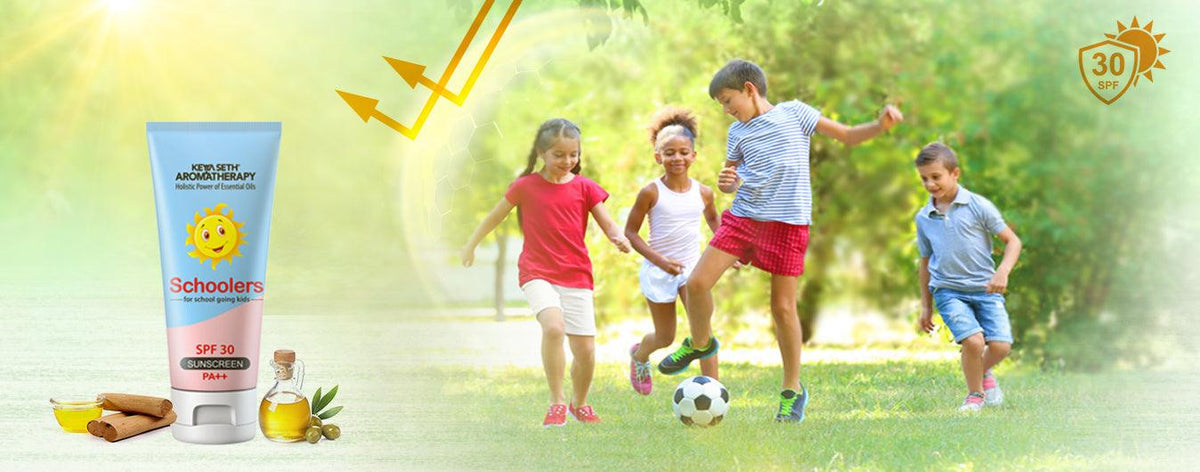
Specially designed for School-going Kids and above, Keya Seth Aromatherapy presents Schoolers Sunscreen. Keep in mind Kids’ sensitive & delicate skin; this sunscreen is formulated with Sandalwood Essential Oil, rich Olive Oil and UV filter Tinosorb M with PA++ and SPF 30 facility prevents suntan and keeps itches & rashes away.
Sunscreen should be applied around 15-20 minutes before going out into the sun and reapplied at least once every two hours and after water exposure, such as swimming or sweating. 2 mg of lotion/cream on every square centimetre of exposed skin or around six to nine full teaspoons to cover the body of an average adult. For kids, three to four teaspoons cover the body.
Don’t purchase sunscreen with PABA, which can cause skin allergies. Avoid the ingredient oxybenzone, which may have hormonal properties. Teens & preteens should choose a good Sunscreen with Broad spectrum UVA-PF protection. (Elana Pearl Ben-Joseph, 2021). Make sure the sunscreen you give children should be non-irritating to the eyes.

0 comments